
Hank
A Welsh cowboy tale

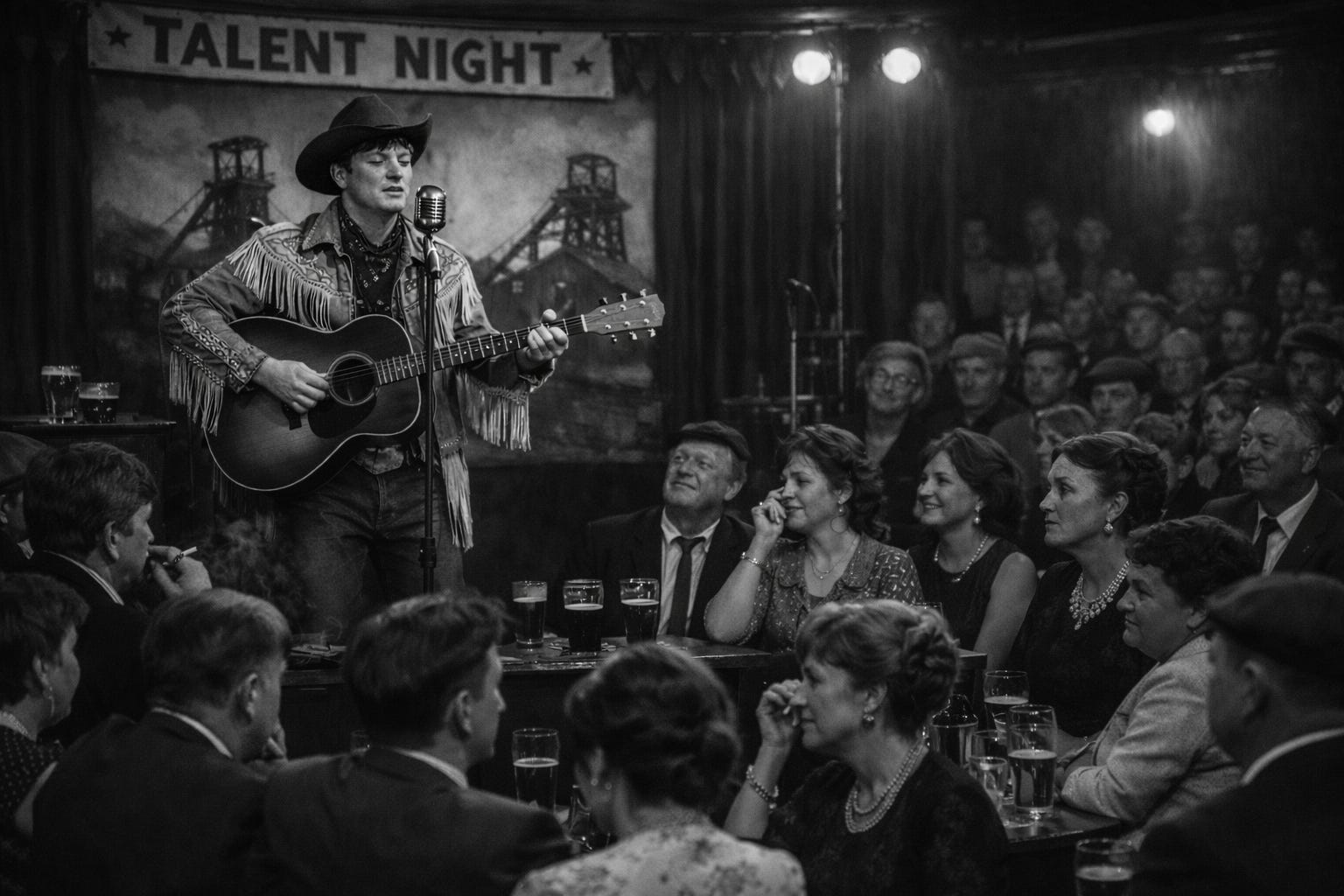
The final chime dripped from the clock with an almost palpable pause of grandeur. It was pompous or mocking, depending on one’s level of irony.
It announced either the glowing dawn of a new era, or chided yet another year of faded and unrealized ambitions. For Hank Price it was the latter, and as he dropped his authentic tooled-leather cowboy boots onto the coffee table, he gave a long sigh of frustration.
Hank was not his real name, although the long-adopted affectation was now as ingrained as if he had been born with it. Reginald had been his birth name, a cursed designation bestowed by his parents moments after he entered the world at Pontypridd Maternity Hospital.
Baby Reginald was doomed to become Reggie, and for the better part of his childhood bitterly battled the vortex of mediocrity the name tried to suck him into.
Not a bright student, he nevertheless found in himself a modest talent for song and, as he eased into adulthood, he immersed himself in an increasingly enticing world of Country and Western music.
By the time he left school and followed his father and uncles into the pits, he could play an adequate number of chords on a gleaming guitar and had developed a repertoire of hurtin’ music sung with a Tennessee drawl, tinged with a Welsh lilt.
As he gradually adopted more and more Western characteristics, his personality began to outgrow his name, and soon he realized Reggie had to die. The name could no longer exist clothed in the short-brimmed Stetson, the rawhide fringed jacket, the black silk shirt, the Lee Rider jeans and Navajo belt buckle, and finally the boots themselves—gorgeous Tony Lamas in black and white snakeskin with red stitching on the sides. These were the final purchase that would stamp Reggie into oblivion with their two-inch riding heels.
One Friday night he stood in front of his bathroom mirror. His skin had been scrubbed clean of coal, his hair swept back and oiled. A slight stubble on his chin enhanced the cowboy look. He loved what he saw and donned the hat with slow, languid movements, finally tipping back the rim in a jaunty salute.
Reggie was still there somewhere. There was a hint of shyness in the eyes, a nervous weakening in the mouth, as if he wondered what was about to happen. His reflection lit a rolled cigarette with cupped hands. It drew a lungful of smoke and held it inside as if to purge the cowering spirit of its old self. With a long exhale, Reggie was blown out into the room where he hung from the ceiling in twisting tendrils.
“Adios, amigo,” the reflection softly chimed, and as the old Reggie floated out the window, Hank was born. The face that looked back had changed. The jaw was firmer, the eyes darker, more brooding. He smiled and, with a final symbolic act, crushed the cigarette into the sink.
The Llandyfawr Miners’ Social Club, packed for the night’s talent show, experienced a minor case of culture shock when Hank walked into the room. He paused for effect at the double doors, guitar case slung over his shoulder.
There was immediate silence followed by:
“Bloody hell, it’s John Wayne.”
“No, it’s the Lone Ranger. Where’s Silver, Reggie?”
“Roy Rogers!”
“Dale bloody Evans!”
The room erupted in laughter but Reggie—now Hank—was above the humour. He walked the gauntlet of their jibes with a slight bow-legged gait and waved to the crowd with fingers pointed into mock pistols. He raised his Stetson to a blushing Aggie Williams, paused to take a pretend swallow of Wyndham Gibbons stout, and wiped his mouth with the relish of a buckaroo just in from riding the herd.
By the time he reached the bar, the spectacle was over and the crowd had returned to their bingo. Hank propped his guitar case against a stool and with his oddly flavoured accent, ordered a Jack Daniel’s.
A bemused Carol Pritchard stood stiffly behind the counter, silently wishing someone else was there to serve. She tugged a frizzed strand of coppery hair behind a gaudily hooped ear.
“Whassat, mon?” she replied. Her knowledge of drink was limited to pints, ports, and the occasional gin and tonic for the ladies.
“It’s like American whisky Carol.”
“Whisky? Then why didn’t you say so, mon? Scotch or Irish is it?”
“You don’t have Jack Daniel’s then?”
“Of course not, Reggie. If it’s a drink with a name you want, we’ve got some Johnnie Walker. Would that do?”
“It’s not Reggie any more, Carol. I’m Hank now.”
Carol did not even blink. She simply gave him a quizzical look, as if the appearance of a cowboy in a Welsh social club was an everyday occurrence, and repeated her question.
“Johnnie Walker is it, Mr. Hank?”
He pulled the brim of his hat low over his eyes, placed another rolled cigarette in the corner of his mouth, and replied with an enigmatic nod.
Carol responded with an equally enigmatic raised eyebrow and poured an ounce of Scotch. He blew smoke over her head, picked up the glass to examine the amber liquid, then knocked it back in a swift cowboy gulp.
She watched him warily. The Reggie she knew was an odd one—shy and quiet, he had always kept to himself. She had seen him at a few Country and Western nights humming along with the performers. Occasionally he took a karaoke microphone and sang a ballad. He had worn a cowboy hat or shirt, but never a full costume like this. What was it about him that seemed so different—something more than the clothes?
“Carol?”
She jumped at the mention of her name. It sounded… American.
“Yes, Mr. Hank. Another Scotch would it be?”
“Just Hank, ma’am. Just Hank. Yup. Only one more though. Gotta keep ma voice loose.”
“You’re singing in the show tonight then… Hank?” She slid the Scotch across the bar, just like in the films.
Hank neatly fielded the glass between finger and thumb and in one fluid motion, swept it to his mouth. He swallowed the liquid and slid the glass back to her hand. It could not have taken more than four seconds, and was concluded with a wicked wink.
Carol felt a flush of heat in her cheeks. By the time she had the glass in the sink, the back of her knees were moist with perspiration and her face was beet red. Embarrassed, she rushed off to the ladies’ room to recover.
Feeling increasingly confident, Hank turned towards the lounge where the bingo was drawing to a close. Amid the scrape of chairs there were mutterings of frustration and jealousy over Mrs. Owens’ second jackpot win in two weeks. Less charitable undertones suggested a questionable relationship between her and Jones the butcher who plucked the numbered balls from the basket.
The men filed up to the bar to refill their glasses and order fresh drinks for the wives. Carol reappeared from the ladies’ room, back in control and ready to man the ale pumps. Sidestepping the crowd, Hank retrieved his guitar case and moseyed to an empty table by the stage. He ignored the chuckles from the women who were more used to Reggie in a flat cap with a half cigarette behind one ear.
Jones the butcher, after clearing away the bingo cage, now slipped into the role of master of ceremonies. The men were returning with full glasses as he tested the microphone with an annoying tap and loud countdown from five.
“Can you ’ear me at the back?” was greeted with a chorus of “ayes” from the audience.
“Let’s get this show on the road then!” And with a flourish he announced the first act to a tumult of cheers and foot stamps.
The night progressed with a procession of the valleys’ local talent. There were the old familiars: Willie Evans the Elvis impersonator in authentic blue suede shoes; Sally Parry singing Dusty Springfield with a precarious blonde beehive. Dai Hughes elicited squeals of pleasure from the ladies doing a passable Tom Jones in overly tight trousers.
Children and grandchildren danced shyly in the spotlight, encouraged by mums and nans. Young Charlie Pugh in a top hat and fake moustache dazzled the crowd with a display of magic tricks honed from hours in his bedroom. It was a long and enjoyable night for the folks of Llandyfawr.
By the time Reggie’s act was announced, the audience was getting restless. It had been a long day at the colliery and the men were looking at watches and longing for their beds.
“What’s it to be tonight, Reggie? Bit of Roy Rogers, some Gene Autry, Johnny Cash?” Jones queried with a chuckle.
Reggie ignored the sarcasm and strode onto the stage, guitar shouldered and ready for action.
The crowd was briefly reanimated and a chorus of whoops emerged from a table of rowdy young lads at the back. Hank ignored them and leaned in to adjust the microphone.
“Howdy, folks,” he tried to mask the valley accent.
“I’d like to try something different tonight, a little collection of songs I put together. I ’ope you like them.”
A fresh muttering from the crowd suggested at this juncture of the night they weren’t particularly interested in songs of unfaithful spouses and faithful dogs, nor whisky-soaked laments of lonesome men wandering lonesome prairies. He sensed he was in danger of losing them and quickly pushed on with a few stiff chords of introduction.
And then he did something that surprised them all.
Hank sang about the coal.
He began stiffly but as his voice and fingers loosened up, his playing steadied and his baritone voice grew stronger and louder.
For the next ten minutes he sang a medley of aching miners’ songs that mirrored the hardship of lives past and present. His voice, not perfect by any measure, seemed to perfectly capture the soul of every lyric—singing of dark and dreary mines, blood blackened by coal, lost youth labouring where sun never shines.
The ripple of conversation ebbed as the verses flowed, eventually stilling to rapt silence. Although words could only hint at what it was like, soon every man and woman in the room felt the songs were for them, and for their fathers and grandfathers.
They remembered their childhoods long before the pits were modernized, when men returned home black with dust. They remembered scrubbing backs in zinc tubs as mothers and grandmothers poured kettles of warm water over stained shoulders.
They remembered their grandfathers’ hands, scarred and bent, tattooed with blue veins that never carried blood. They remembered the awful hacking cough of lungs choked by dust—a cough that echoed around the world as miners from all nations struggled in poorly ventilated shafts.
Generations of memories seeped back into the room as he sang. Like smoke from coal fires that warmed the miners’ homes, it crept into their hearts and although most hid their emotions well, many dabbed their eyes hoping no one would notice.
When Hank finished with a coda of sad finger-picked chords, the applause was sparse. A smattering spread and quickly died. As Hank re-cased his guitar, even Jones seemed at a loss for words, stuttering a thank you and trying to urge the audience to a further round of clapping. To no avail.
Hank gave a quick bow and left the stage aware people were watching him differently. Even Carol Pritchard looked on with an expression of new interest. But their reaction left him puzzled and he could not shake the feeling his performance had been a failure.
He never suspected his songs had set a chord of nostalgic melancholy vibrating in his audience, and even they were unsure how to react. Embarrassed to show they had been moved, they were ashamed of their vulnerability and avoided his eyes. Disheartened and uncomfortable Hank decided it best to retreat and wove his way around the tables.
Nearing the door, he saw old Billie Williams at the last table nursing the remains of a pint. Billie was in his eighties and long retired. He had lived through all Hank had sung about, never knowing a life any better. He reached out a bony hand and clutched Hank’s arm as he passed, pulling him down to face level.
Hank looked into the watery eyes from which a faint spark of youth still seemed to glow. It had not been extinguished by a life underground. He felt the old man’s strong grip—one that still had power from decades of labour. Billie nodded and the corner of his mouth turned up in a half smile.
“Ye’ did us proud, Reggie,” was all he said before letting go and turning back to his glass.
Hank stepped into the cold air and looked across the valley. A fog rolled down the far side diffusing the lights of row houses built a century ago.
He had entered the club as Hank that night, but walking home through the thickening mist, the jaunty cowboy who had borne him in became less confident. With each click of the riding heels, a small piece of his character seemed to fall away.
By the time he reached home Hank realized that perhaps being Reggie was not so bad after all — he deserved another chance.
Theses paragraphs were my favourite.
“ Friday night he stood in front of his bathroom mirror. His skin had been scrubbed clean of coal, his hair swept back and oiled. A slight stubble on his chin enhanced the cowboy look. He loved what he saw and donned the hat with slow, languid movements, finally tipping back the rim in a jaunty salute.
Reggie was still there somewhere. There was a hint of shyness in the eyes, a nervous weakening in the mouth, as if he wondered what was about to happen. His reflection lit a rolled cigarette with cupped hands. It drew a lungful of smoke and held it inside as if to purge the cowering spirit of its old self. With a long exhale, Reggie was blown out into the room where he hung from the ceiling in twisting tendrils.
“Adios, amigo,” the reflection softly chimed, and as the old Reggie floated out the window, Hank was born. The face that looked back had changed. The jaw was firmer, the eyes darker, more brooding. He smiled and, with a final symbolic act, crushed the cigarette into the sink.” Very poignant, thanks.jill.
A well spun, humbling tale about one person in the span one of night, and yet....it stirred hope. I was wishing on a coal-dusted star that Reggie and Carol marry, run away and he changes his name to Hank.